
Camel Trekking in Morocco: Sahara Desert Rides and Mountain Adventures
There are places in Morocco best explored on foot or by camel rather than from a car. Camel trekking in Morocco offers a different way to experience desert landscapes, traditional villages and local culture. Depending on your interests, you can choose a camel ride in the Sahara, a walking trek in the Atlas Mountains or a trip that combines outdoor activities with cultural experiences.
Morocco also offers opportunities to learn about local food, traditional crafts and everyday life. Explore the options below to find an experience that suits your travel plans.

A camel trek is a memorable way to explore Morocco’s desert landscapes. In the Sahara, you can travel across sand dunes, pass palm groves and oases, and see kasbahs along the way. The scenery changes with the light, while the quieter pace offers time to appreciate the surroundings.
Depending on the trip, you may spend the night at a desert camp beneath the stars. Some experiences include traditional tents, local food, stories or music around the camp. The exact arrangements depend on the tour you choose.
Discover more about camel rides and trekking in Morocco.
Explore our full range of Morocco tours to find the perfect itinerary for your trip.


North Africa’s highest mountain, Jbel Toubkal, stands at approximately 4,167 metres in the High Atlas Mountains. The surrounding area offers mountain trails, traditional Amazigh (Berber) villages and views across valleys and rugged slopes.
You can explore the region on foot, with local muleteers helping to carry equipment where arranged. Reaching the summit of Jbel Toubkal requires a mountain hike; camels are not a means of reaching the summit. Depending on your itinerary, you may stay overnight in a village guesthouse or mountain refuge.

Explore the landscapes of the Sahara and the Saghro region on a longer trekking adventure. The route described for this 13-day tour combines mule and camel trekking with time in Morocco’s desert and Anti-Atlas landscapes.
Expect varied terrain, warm days in some areas and cooler nights, depending on the season and altitude. The trip offers an opportunity to experience the open spaces and quieter landscapes of southern Morocco.
Read more about camel trekking in Morocco.

After arriving in Marrakech, you will be met by your guide and transferred to your hotel for the night. The following day, travel to the foothills of Jbel Toubkal, around 60 km from Marrakech according to the original itinerary.
In the morning, meet the muleteers from the village of Imlil before setting out to explore the surrounding landscapes and mountain villages. Along the way, you may have opportunities to meet local Amazigh families and learn about life in the High Atlas.
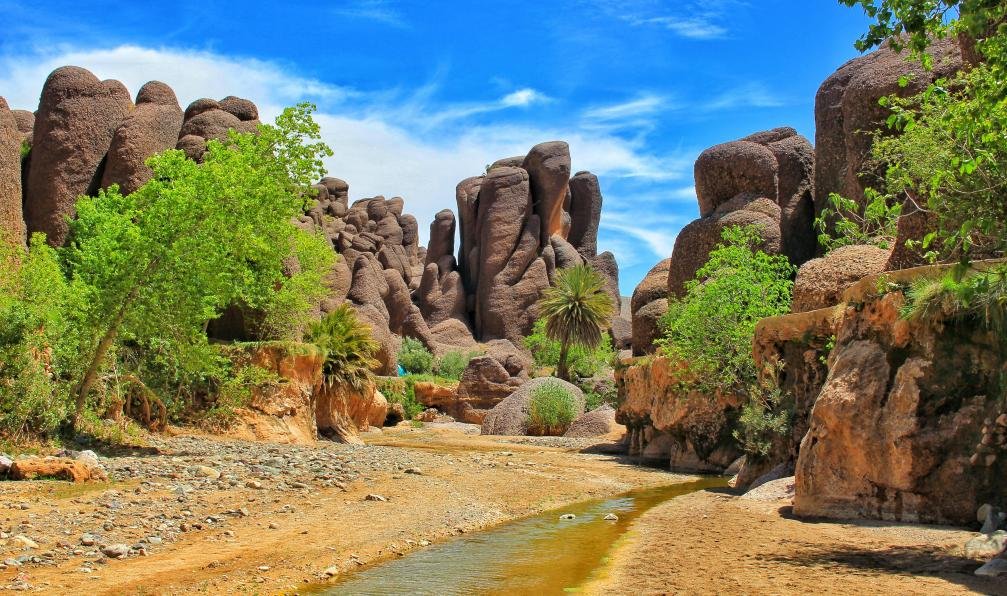
Travel south from Marrakech toward the southern slopes of the Atlas Mountains and meet your muleteer team in the village of Tamalakout. The trek passes through mountain villages and valleys before continuing toward the volcanic summit of Siroua, which reaches approximately 3,500 metres.
Highlights described for this trip include mountain and valley views, the sheep pens associated with the Ait Ouakoustit community, time with the local muleteers and the climb toward Siroua’s summit.
Beyond camel trekking and mountain walks, Morocco offers opportunities to explore traditional crafts, food and local customs. The activities below are drawn from the original page; availability, locations and arrangements should be confirmed before booking.
Morocco is multilingual, with Moroccan Arabic (Darija), Amazigh languages and French widely used in different settings. English and other languages are also spoken, particularly in tourism.
The original description for this activity repeats the arrival and mountain itinerary involving Marrakech, Imlil and local muleteers. The precise language-learning activity and its location need to be confirmed before this section is published as a bookable experience.
Morocco has a long tradition of beekeeping and honey production. A visit to a local apiary may offer insight into how honey is produced and how regional plants influence its flavour.
The original description refers to traditional apiaries and honey tasting. Confirm the location, producer and tasting arrangements before advertising these as included activities.
Discover traditional Moroccan craftsmanship through pottery and tadelakt, a polished lime-based plaster used in Moroccan architecture. Depending on the workshop, you may learn about the materials, techniques and decorative finishes used by local craftspeople.
A hands-on course should be confirmed with the provider, including the location and the techniques participants will have the opportunity to try.
Food is an important part of Moroccan culture, and a cooking class can introduce you to traditional ingredients and preparation methods. Depending on the class, you may learn to prepare dishes such as tagines, savoury or sweet pastillas, Moroccan pastries and traditional breads.
The original description mentions cooking with local families and learning recipes passed down through generations. Confirm whether family-hosted classes and each of these dishes are actually included before making those promises.
Learn about argan oil, a plant oil produced in Morocco and used in cosmetic products as well as food. Some experiences may include an introduction to traditional massage practices or a visit to a hammam, a Moroccan steam bath.
The original offer describes a two-hour massage, learning about argan oil extraction and a hammam experience. These are separate services that should only be advertised as available once their providers, locations, duration and inclusions have been verified.
Mountain biking offers another way to explore Morocco’s countryside and mountain scenery. The original description lists two levels: a beginner ride and a more challenging route. Confirm the locations, difficulty levels, equipment and guiding arrangements before presenting these options as available tours.
Henna is a traditional form of temporary body art made using dye from the henna plant. In Morocco, henna designs are associated with celebrations and cultural traditions. During a henna session, a local artist may explain the designs and apply a pattern of your choice. The meaning of individual motifs varies, so it is best to ask the artist about the specific design rather than assuming that every pattern has a fixed meaning.

Morocco Desert Tours offers tours for travelers interested in Morocco’s desert landscapes, cities and cultural heritage. Options described on the original page include Sahara trips and visits to destinations such as Fes and Marrakech.
Explore the available tours and choose an experience that fits your interests, schedule and travel plans. To enquire about a booking, contact the team through the website’s online form.
Planning a camel ride in Morocco? The answers below cover common questions about camel trekking, preparation, comfort and animal welfare.
Camel trekking involves riding a camel, usually a one-humped dromedary in Morocco, as part of a short excursion or a longer desert trip. Depending on the location and itinerary, the experience may include crossing sand dunes, visiting desert areas or reaching a camp.
Sahara camel treks are often associated with destinations such as Merzouga. Camel rides are also offered near Marrakech, including in the Agafay area, which is a rocky desert landscape rather than part of the Sahara.
There is no single weight limit that applies to every camel or tour. Restrictions may depend on the animal’s condition, the equipment, the duration of the ride and the operator’s animal-welfare policy.
Ask the provider about its specific requirements before booking. Responsible operators should put the camel’s health and comfort ahead of accommodating every rider.
Camel milk is consumed in parts of North Africa and other regions, but it is less widely available in many Western supermarkets than cow’s milk. Differences in production, processing, distribution and availability help explain why.
Do not assume camel milk will be served on a desert trip. Ask the tour operator in advance if tasting it is important to you.
The ethics of camel trekking depend on how the animals are treated and how the activity is managed. Important considerations include suitable workloads, access to water and appropriate food, adequate rest, suitable equipment and proper veterinary care.
Before booking a camel trek in Morocco, ask the provider about its animal-welfare practices. Avoid operators that overload animals, use poorly fitted equipment or continue rides when an animal appears injured, exhausted or distressed.
Animal care varies between owners and operators, so it is not accurate to assume that all camels receive the same treatment. Look for visible signs of good care and ask how animals are fed, watered, rested and checked for injuries.
If you have concerns about a camel’s condition, do not ride it. Choose a provider that can explain its welfare practices clearly
Camels are strong animals adapted to carrying loads, but that does not mean every camel is comfortable with every workload or riding condition. Their welfare depends on their health, training, handling, equipment and the weight they carry.
Avoid claims that camels enjoy being ridden simply because they appear calm. Responsible handling and appropriate workloads are more useful indicators of good practice.
Camel riding can cause discomfort or injury if an animal is overloaded, poorly equipped, inadequately rested or handled badly. Properly fitted saddles and balanced loads can help reduce the risk, but they do not guarantee that an animal will never suffer.
Choose operators that use suitable equipment, monitor their camels’ condition and allow adequate rest between rides.
Riding a camel involves a rocking or swaying motion, particularly as the animal stands up and sits down. Some travelers find the movement enjoyable, while others may find it uncomfortable.
Wear practical clothing, follow the handler’s instructions and let the operator know if you have mobility concerns or difficulty mounting and dismounting. A short ride may be a better choice if you are unsure how comfortable you will find the experience.
A camel ride can be a way to experience the landscapes outside Marrakech without travelling all the way to the Sahara. However, the setting differs by location: rides near Marrakech may take place in palm groves or the rocky Agafay landscape, while Sahara trips offer access to large sand dunes in destinations such as Merzouga.
Choose the experience based on the landscape you want to see, how much time you have and whether you want a short ride or a longer desert trip.
Early morning and late afternoon are often more comfortable than the hottest part of the day, and the light can be suitable for photographs. Actual conditions vary with the season and weather, so confirm the planned departure time with your provider.
For more information about trips near Marrakech, see the original Agafay desert day trip page.
Comfortable, loose-fitting trousers can help protect your legs from rubbing against the saddle. A lightweight scarf may be useful for sun protection and dust. Closed shoes, sun protection and clothing suitable for the weather are also practical choices.
There is no special outfit required specifically for women, but modest, comfortable clothing may be preferable depending on the location and personal preference.
As with any animal activity, camel riding carries some risk. Safety depends on the animal’s condition, the handler’s experience, the equipment, the terrain and the rider following instructions.
Before booking, ask how the ride is supervised, whether suitable mounting assistance is available and what safety measures the operator follows. No provider can guarantee a completely risk-free experience.
Whether you are interested in camel trekking, mountain walks or cultural activities, choose an experience that matches your interests and travel schedule. Check the itinerary, inclusions, accommodation and animal-welfare arrangements before confirming your booking.
To enquire about a tour, visit Morocco Desert Tours and use the website’s contact form.